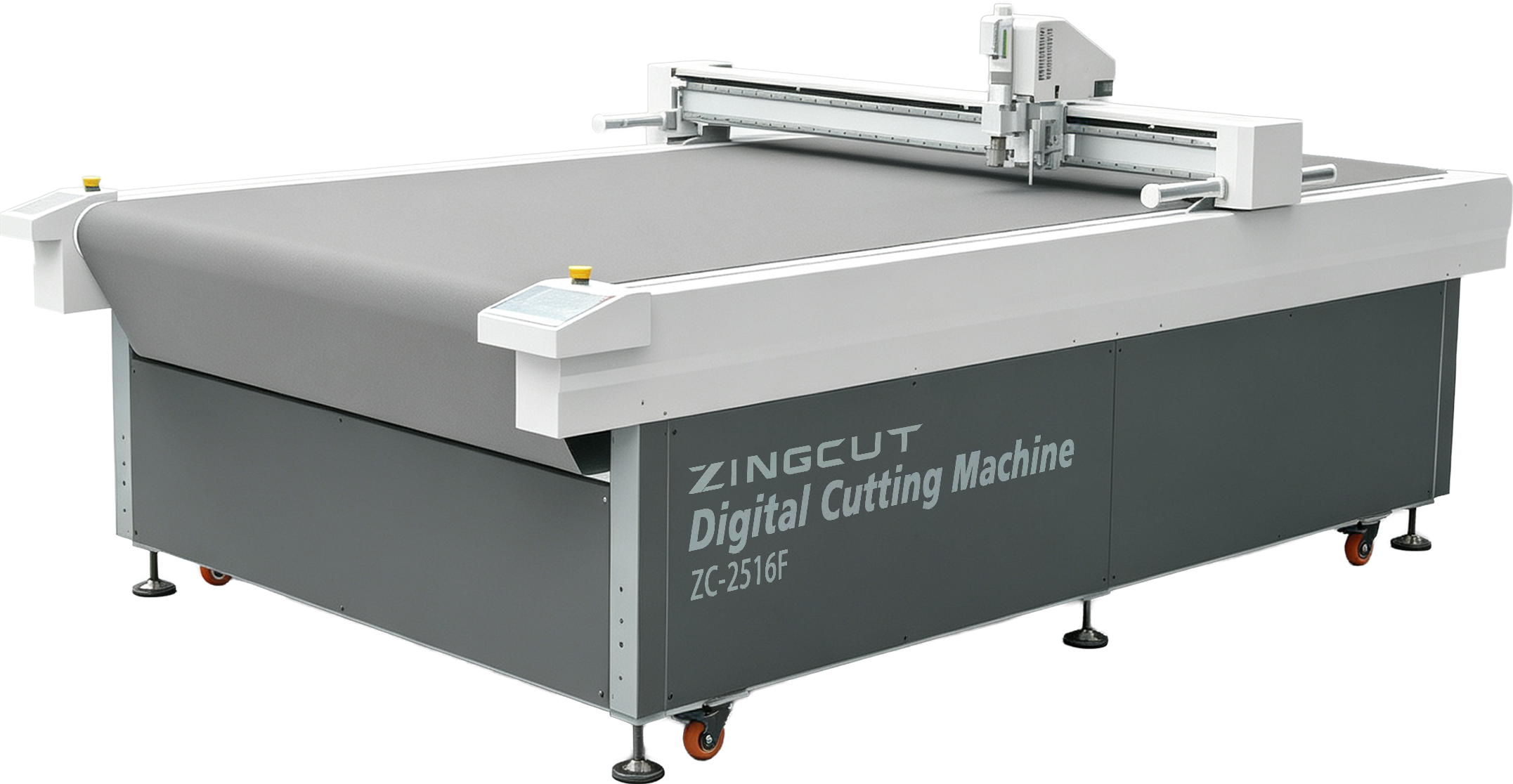
Introduction
In the apparel manufacturing industry, the cutting machine is often viewed merely as the first step in the production line. However, in today’s era of small-batch, fast-turnaround orders running parallel with high-end customization and mass production, it has actually become the “first gate” determining delivery cycles and profit margins. Suits fear deformation, shirts fear frayed edges, and everyday wear fears interlayer slippage. These losses are often dismissed in the sewing workshop as “fabric issues” or “worker issues,” but the root cause usually lies at the cutting machine.
Today, starting from the real pain points of the industry, let’s discuss how to choose a flexible cutting machine that truly understands fabrics.
1. What is a True Apparel Flexible Cutting Machine?
1.1 The Cutting Machine is More Than Just a "Cloth Cutting Tool"
If you still view the cutting machine as a device that just needs to “cut fast,” you are greatly mistaken. Under today’s production pace, cutting machines must handle highly fragmented orders. It needs to cut accurately and adapt to frequent fabric and pattern changes within a single day. The efficiency of the cutting machine directly dictates whether the entire production line can flow smoothly.
1.2 Why Are Suits, Shirts, and Everyday Wear Hard to Cut Precisely?
Different apparel categories have completely different pain points:
· Suit Fabrics: Complex yarn structures and high tear strength make them prone to wrinkling during spreading. More critically, roll fabrics are stretched under feeding tension and slowly retract after cutting. This causes the size drift of precisely cut pieces, ruining the accuracy of matching stripes and plaids.
· Thin Shirt Fabrics: High layer counts and thin materials mean every up-and-down movement of the blade disturbs the stack, easily causing loose threads and frayed edges. If thermal cutting is used, it also leads to melted, hardened, and discolored edges.
· Everyday Mixed Fabrics: High-elastic knits and functional composite fabrics often have varying interlayer friction coefficients, making interlayer slippage highly likely during multi-layer cutting.
2. How Do Cameras and Sensors Handle the "Irregularities" of Complex Fabrics?
2.1 Method 1: How Do Vision Cameras Solve "Stripe and Plaid Matching" in Suits?
For striped, plaid, or printed fabrics, vision cameras act as a substitute for human eyes. They scan the fabric surface before cutting, automatically identify pattern feature points, and correct the cutting path in real-time to ensure patterns match perfectly when the pieces are sewn together.
2.2 Method 2: How Do Sensors and Tension Control Handle Thin Shirt Fabrics?
To address the pain point of thin shirt fabrics and suit fabrics “shrinking after cutting,” relying solely on machine precision is not enough, because every fabric roll has a different shrinkage rate. ZINGCUT’s approach lies in making tension estimation an adjustable, front-end variable. We do not rely on operators’ experience to fix pieces after the fact. Instead, we execute the cutting path under relatively stable tension. As a result, the dimensional drift of cut pieces after leaving the table is compressed into a range that the sewing process can fully absorb.
2.3 Which Recognition and Control Method Should You Choose?
If your factory handles both solid-color suit fabrics and heavily printed fabrics, never use a single set of parameters to “rule them all.” An excellent recognition and control solution must switch flexibly based on fabric properties—letting the vision system identify patterns and the sensors stabilize tension.
3. In Continuous and Multi-layer Cutting, Which Machine Structures Are Crucial?
3.1 Continuous Feeding Structure is the Prerequisite for Efficiency
For high-volume everyday wear, a continuous roll-feeding structure can significantly reduce the downtime of re-spreading fabric. If the cutting machine can switch from one version to the next without stopping and with continuous fabric feeding, that is true efficiency.
3.2 The Method of Securing Fabric Should Match the Material
During multi-layer cutting, if compression is insufficient, layers will shift. Many factories blame this on “fabric being too slippery,” but in reality, it depends on the machine’s constraint method. The vacuum adsorption and cutting action synergy adopted by ZINGCUT in multi-layer cutting scenarios is not meant to “press the fabric to death” (which destroys fabric resilience), but to maintain the relative position between layers locally where the blade passes. When interlayer misalignment is reduced, multi-layer cutting truly means “saving labor hours” rather than “creating rework.”
3.3 Structural Rigidity and Vibration Suppression Determine Long-term Precision
If high-frequency vibration is poorly controlled, it causes machine squealing and structural fatigue, leading to blade breakage and wear. The straightness of the beam requires repeated manual adjustment. Every blade change and machine adjustment stops the entire line’s rhythm. These hidden costs don’t appear on the fabric purchasing list, but they are silently eating into your profit.
4. Which Cutting Tools Are More Suitable for Suits, Shirts, and Everyday Wear?
4.1 Why Should Thermal-sensitive Thin Fabrics (Shirts) Never Use Lasers?
Laser cutting is fast, but it is an absolute disaster for thin shirt fabrics. High temperatures cause thermal-sensitive fabrics to burn at the edges, melt, and stick together, hardening the cut. Once the edges of shirt pieces harden, the subsequent overlocking process cannot proceed at all.
4.2 Matching Logic Between Rotary Blades and Oscillating Blades
Soft fabrics usually use rotary blades, but for thicker, harder materials, or multi-layer thin fabrics requiring extremely high precision, a high-frequency micro-stroke oscillating blade is the better solution. ZINGCUT’s oscillating knife uses cold cutting, applying zero thermal input to the fabric. It completes the cut through high-frequency micro-strokes rather than tearing. The edge condition can directly enter the sewing process, completely eliminating the extra trimming hours reserved for frayed edges.
4.3 How Do Punching and Marking Tools Fit into Complete Production?
Cutting is not an isolated step. Directly punching positioning holes or adding markings on the cut pieces can greatly reduce the difficulty for sewing workers to find alignment points, enhancing the proficiency of the entire assembly line.
5. How Should Buyers Choose the Right Cutting Bed Size and Configuration?
5.1 Cutting Width and Fabric Roll Width First
The most basic selection principle is to match the fabric roll width. Do not let the machine become a bottleneck limiting your fabric choices.
5.2 Production Mode Determines the Machine Type: Mass Production vs. Small-batch Fast-turnaround
The traditional die-cutting model is no longer viable in the era of fast-turnaround small orders. Die costs are high, and die-changing takes a long time. If you need to cut 20 small orders a day, the core metric of a cutting machine’s quick-response capability is not the maximum cutting speed, but how long it takes to switch from one version to the next. Digital cutting turns pattern switching into file switching—that is the fundamental solution.
5.3 My Practical Selection Rule: Calculate the "Hidden Cost" Account
When buying equipment, the purchase price is just the tip of the iceberg. Add the downtime, machine adjustments, blade changes, and scrap rates over three years—that is the real cost. The true cost of a cutting machine = Purchase Price + The money it makes you pay extra due to instability.
6. How Does Software Affect the Final Quality of Contour Cutting?
6.1 Recognition and Layout Must Be Easy to Set Up
Frontline operators are not programmers. The more foolproof the software interface, the lower the training costs and error rates for the factory.
6.2 Cutting Paths Require Algorithmic Compensation
Nesting software can calculate fabric utilization beautifully, but if the cutting machine’s execution capability for sharp corners and arcs is insufficient, it cannot cut qualified pieces no matter how densely packed they are. Trajectory precision must support high-density nesting.
6.3 Nesting and Layout: Every Centimeter Saved Must Be Realized
Every centimeter saved by nesting software is predicated on the cutting machine’s trajectory precision being sufficient to support high-density layouts (such as common-line cutting and extremely narrow gaps). Only the perfect synergy of software and hardware can turn on-screen utilization rates into actual profits on the books.
7. What Should Buyers Test Before Ordering a Flexible Cutting Machine?
Do not just watch the machine cut white paper in the showroom. You must bring your own fabrics.
7.1 Test Real Suit/Shirt Fabrics, Not Just Paper
Paper has no tension and does not shrink. Bring your most easily deformed and difficult-to-handle fabrics to see if the dimensions are precise after cutting.
7.2 Test the Interlayer Deviation Rate in Multi-layer Cutting
Spread 20 layers of thin fabric. After cutting, measure the dimensional difference between the bottom layer and the top layer. See if the interlayer slippage is within an acceptable range for sewing.
7.3 Test the Pattern Switching and Operator Workflow
Let your factory’s skilled workers operate it. See how many people and how much time it takes to go from importing drawings and nesting to completing the pattern switch and cutting.
7.4 Test the Actual Cutting Edge Condition
Look at the cut edge under a magnifying glass. Are there loose threads or frayed edges? Is there burning or yellowing? This directly determines how much trimming cost you need to add to the subsequent processes.