Introduction
In the bag industry, the pain points of flexible cutting cluster around three dimensions: material adaptability, precision consistency, and small-batch fast-turnaround efficiency. Delamination in laminated fabrics, stretching in genuine leather, misalignment in multi-layer cuts, tooling costs for dies, and changeover that depends on veteran operators — these problems eat directly into margin.
1. Laminated Fabrics Delaminate the Moment They're Cut — Is It the Glue, or Is the Blade Just Too "Violent"?
Laminated materials are everywhere in bag making, and they’re also where cutting problems show up first. The moment you cut through multiple layers with different stretch rates, the failure mode is predictable — and it usually isn’t the material’s fault.
1.1 Different stretch rates between layers — a press-and-tear roller blade pulls them apart
Common bag materials — fabric + foam, fabric + TPU film, leather laminate — have layers with different stretch rates. Traditional roller blades rely on compression and tearing, and multi-layer structures are easily pulled apart by external force, causing localized delamination and surface slippage at the cut edge.
1.2 Laser heat burns the interlayer adhesive
Laser cutting runs hot, directly scorching the interlayer adhesive. Synthetic surfaces melt into hard edges, the hand feel is ruined, and the cut edge yellows and hardens — so stiff that a sewing needle won’t go through it later.
1.3 Fabric wrinkles and shifts during cutting — top and bottom contours don't line up
If the fabric isn’t fully secured, it wrinkles or shifts during cutting. The top layer and bottom layer misalign, the upper and lower contours of the cut piece don’t match, and sewing alignment becomes a minefield.
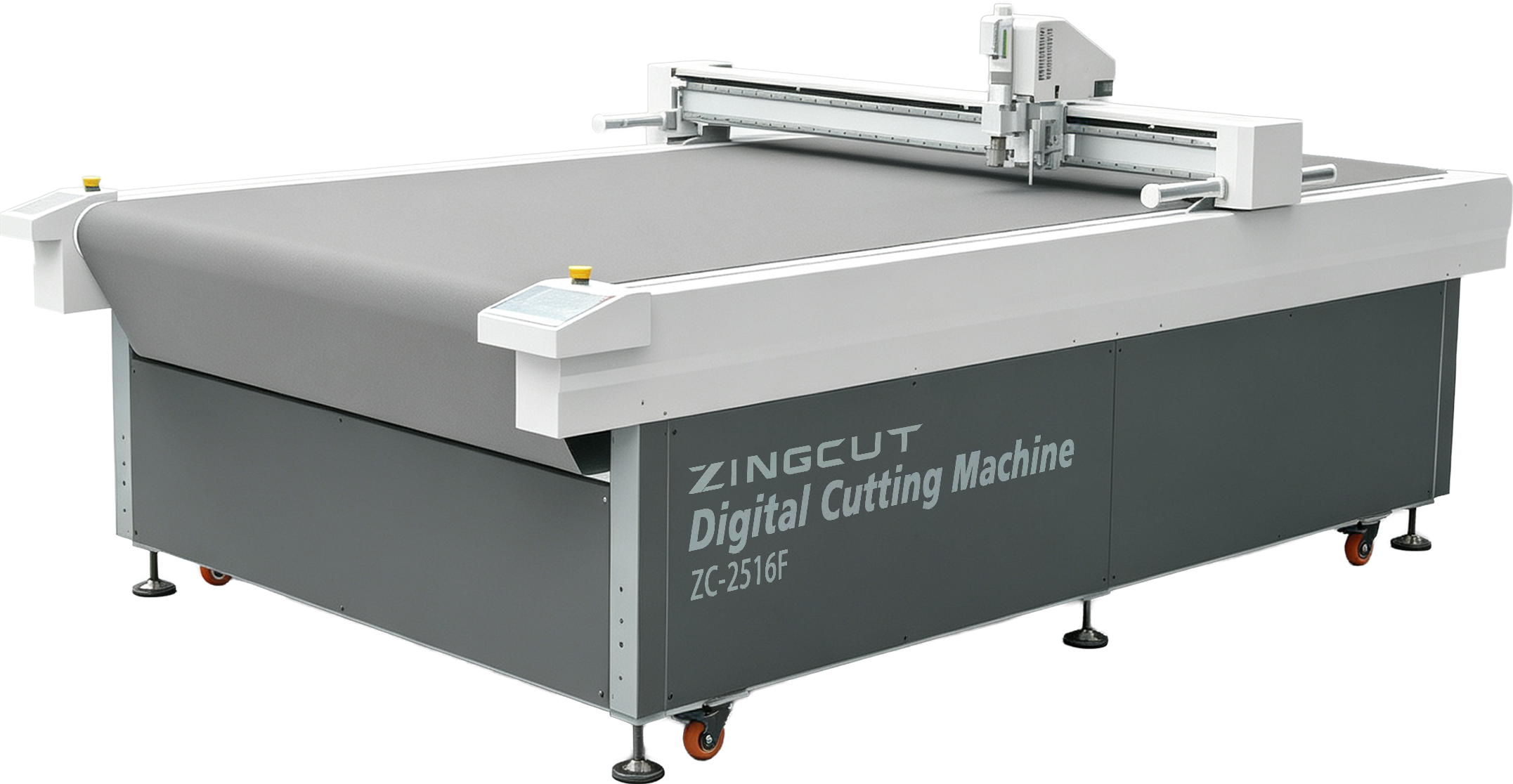
The root cause here is two things left unsolved: heat and fixation. ZINGCUT equipment takes the cold-cutting route — high-frequency micro-vibration of the blade, zero heat transfer throughout — so the adhesive doesn’t melt and the bonded state of the cut edge stays intact. Combined with zoned vacuum adsorption that lays the entire sheet flat and locks it down, the fabric doesn’t wrinkle or shift during cutting, the stretch difference between top and bottom layers is minimized, and contour alignment rates improve noticeably. For factories making laminated handbags and sports bag linings, this single item directly determines the rework rate.
2. Genuine Leather Stretches During Cutting — Is the Leather Too Delicate, or Does the Blade Not Know How to Handle It Gently?
Leather is the highest-value material on the cutting table, and also the least forgiving. Every bit of tension the blade applies comes back as wasted square footage.
2.1 Uneven thickness and inconsistent fiber density — hand cutting relies on feel to control tension
Natural cowhide varies in thickness and fiber tightness across the hide. Hand cutting depends entirely on a veteran’s feel for tension control — apply slightly uneven force at a curve or arc, and the piece stretches and deforms, leaving cut pieces of inconsistent size.
2.2 Die stamping compresses surface fibers — lifting, marks, dents
Die stamping easily compresses and peels the surface fibers of genuine leather, causing lifting, pressure marks, and surface dents. Waste rates on expensive hides stay stubbornly high.
2.3 Stretch deformation makes downstream sewing alignment difficult
Stretched cut pieces have unstable dimensions, making downstream sewing alignment difficult, driving up rework rates — expensive material cut into cheap-looking goods.
For high-value materials like genuine leather, the key is “light.” ZINGCUT equipment uses a high-frequency light-cut approach for leather — the blade descends gently and cuts cleanly, without pulling the leather surface fibers, leaving a flat edge with no chipping, and the surface film doesn’t peel or lift. What’s saved is the manual trimming step; what’s preserved is the usable yield area of every hide. The money saved on material often exceeds the equipment depreciation.
3. Multi-Layer Cuts Won't Cut Through, Layers Stick Together, and Blade Changes Never Stop
Multi-layer cutting is where throughput goes to die — not in one dramatic failure, but in a hundred small stoppages.
3.1 Short blade edge life and poor wear resistance — blunt by the time it reaches the bottom layer
Ordinary blades have short edge lengths and poor wear resistance. They dull by the time they reach the lower layers, causing interlayer sticking and frayed edges. Frequent停机 for blade changes leaves precious little effective cutting time in a day.
3.2 Blade extension length is hard to set — too long and it chatters, too short and it won't cut through
Setting blade extension is tricky: too long and it chatters and chips; too short and it won’t cut through. Adjustment depends entirely on veteran experience — hand it to someone else and they can’t figure it out.
3.3 Layer slippage during stacked cutting — cut piece dimensions drif
Layers tend to slip against each other during stacked cutting, cut piece dimensions drift unpredictably, and yield depends on luck.
Multi-layer flexible materials are the last place you want a “one setting cuts all” approach. ZINGCUT equipment’s blade head configuration and vibration frequency adjustment are designed for multi-layer flexible materials — cutting depth and blade pressure can be quickly calibrated to material thickness, so you don’t have to re-run “half an hour of trial and error” every time you change material. For bag factories that switch between three or four materials a day with small batch sizes, the time saved on changeover debugging is throughput.
4. In the Small-Batch Fast-Turnaround Era, Dies Have Become the Most Expensive "Silent Cost"
The die is a fixed cost that only pays off at volume — and volume is exactly what small-batch production doesn’t have.
4.1 High die cost and long lead time — small batches can't absorb the cost
A set of dies costs several hundred to over a thousand, plus several days of waiting. Make two hundred units of a new style to test the waters, and the die cost spread across each bag directly eats the margin.
4.2 Revisions require new dies — design gets strangled by production feasibility
A designer comes up with an unusual bag base shape, and the die maker says “that curve is hard to tool.” Revisions require new dies, and creativity gets strangled by production feasibility.
4.3 Dies pile up in the warehouse, eventually sold for scrap
For styles that don’t sell, dies take up warehouse space and eventually get sold for scrap. Silent costs accumulate.
The logic of digital cutting is simple: no dies. Design files go straight into the machine — irregular shapes, arcs, and cutout patterns all cut without issue. Change a curve or a dimension, drag it in the software and you’re done: zero tooling cost, zero waiting period. ZINGCUT equipment follows exactly this path — for OEM contract manufacturing, streetwear bag brands, and small-batch custom production, this is essentially a must-have.
5. Suction Set Wrong — Thin Materials Deform, Thick Materials Shift
Vacuum adsorption is a double-edged sword: get it right and everything stays put; get it wrong and you’ve introduced a new variable into your yield.
5.1 Too much suction — thin, soft lining fabric gets pulled out of shape and wrinkles
Thin, soft lining fabric gets sucked into deformation and wrinkles, cut dimensions drift, and the thinner the material, the harder it is to control.
5.2 Too little suction — thick laminated material shifts during cutting
Thick laminated material won’t stay put, shifts during cutting, and by the time the blade finishes, the material has gone crooked.
5.3 One machine goes from thin to thick without changing parameters — yield depends on luck
Many factories run one machine from thin lining to thick EVA without changing parameters, leaving yield to luck and operators adjusting by feel.
ZINGCUT equipment’s zoned vacuum adsorption delivers suction on demand — low suction for thin materials to hold their shape, high suction for thick materials to lock position. Operators don’t need to memorize parameter tables; the interface is clearly tiered, so changing material means changing the tier. Turning experience into a dial — new employees can get up to speed too. That’s probably the most practical thing on a bag factory floor.
6. Conclusion
Across the five areas above, ZINGCUT equipment addresses the core pain points of bag cutting concretely: cold cutting with high-frequency micro-vibration eliminates delamination and heat damage in laminated fabrics, high-frequency light cutting protects genuine leather from stretching and surface lifting, multi-layer blade configuration with quick pressure calibration handles stacked materials without constant blade changes, die-free digital cutting removes tooling cost and lead time entirely, and zoned vacuum adsorption adapts suction to thin or thick materials so operators don’t rely on guesswork. If your factory is losing margin to rework, material waste, or changeover downtime, ZINGCUT is built to turn those variables into controllable, repeatable process — book a demo and bring your toughest material to the table.