Introduction
Composite materials are undoubtedly the “star materials” of modern manufacturing. From automotive lightweight parts and aerospace accessories to new energy components and customized industrial laminates, carbon fiber, fiberglass, prepreg, and honeycomb composites dominate high-end production fields. However, looking beautiful in design does not mean easy processing. Most manufacturers are troubled by various tricky cutting defects: fuzzy edges, layered peeling, thermal melting, material deformation, and fast tool wear. These small cutting problems easily turn into big profit losses, including high scrap rates, repeated rework, delayed delivery, and increased consumable costs.
1.Common Cutting Problems Faced by Composite Materials
Unlike ordinary single-layer materials such as foam, paperboard, and fabric, composite materials feature multi-layer bonding, resin-containing structure, high abrasion resistance, and heat sensitivity. These unique physical properties make them extremely picky about cutting methods, and traditional cutting equipment easily causes the following four major problems.
1.1 Delamination, Fraying and Fiber Pull-out
Composite materials are formed by stacked fibers and resin matrix. Traditional dragging and squeezing cutting methods will tear the fiber structure forcibly. It is easy to cause ply separation at the cutting edge, messy burrs, and exposed pulled fibers. For aerospace and automotive structural composite parts that require high precision, such defective products are completely unqualified and can only be scrapped directly.
1.2 Thermal Melting and Resin Degradation
Most composite resins are heat-sensitive. Laser cutting and blunt blade friction cutting will generate massive cutting heat, forming a heat-affected zone on the edge. Excess heat will cause resin melting, carbonization, edge sticking, and premature curing of prepreg materials, completely destroying the structural stability and original performance of composite parts.
1.3 Unstable Material Fixation and Dimensional Deviation
Dry carbon fiber fabric and fiberglass fabric are soft and easy to stretch; sticky prepreg is prone to displacement during processing; fragile honeycomb core panels are easy to deform under uneven pressure. Traditional cutting tables cannot fix different composite materials in a targeted manner, resulting in overall dimensional offset and inconsistent batch finished products.
1.4 Severe Tool Wear and High Production Cost
Carbon fiber and glass fiber have strong abrasive properties, which will cause rapid wear of ordinary blades. Frequent blade replacement increases consumable costs and affects production continuity. In addition, die-cutting requires customized molds for different composite shapes, which is not suitable for prototype testing and small-batch customized orders, resulting in low production flexibility.
2 .How Vibrating Knife Solves Delamination, Fraying and Fiber Pull-out
The core reason for composite edge defects is “tearing cutting”. ZINGCUT high-frequency oscillating vibrating knife completely changes the traditional cutting logic and realizes true slicing processing.
The blade vibrates up and down at high frequency during operation, cutting off fiber and resin layers instantly with sharp vertical force, instead of squeezing or dragging the material horizontally. This vertical slicing method ensures that the fiber structure is cut off neatly without pulling or stretching.
Meanwhile, the machine supports precise adjustment of cutting pressure and cutting speed according to different composite thicknesses and hardness. For thin dry fiber cloths, low-pressure fast cutting avoids layer stretching; for thick multi-layer composite panels, matched pressure ensures thorough cutting. This perfectly eliminates fraying, fiber pull-out and delamination problems, delivering smooth, inspection-grade clean edges that require no secondary trimming.
3. Is Low-Temperature Environment Necessary for Cutting Heat-Sensitive Composites?
Many manufacturers misunderstand that cutting composite materials must rely on professional low-temperature freezing environment to solve melting edges. In fact, low-temperature auxiliary processing is not necessary for daily composite production.
Industrial cryogenic cutting (liquid nitrogen cooling at -196°C) is only used for ultra-high-precision aerospace composite experiments and ultra-rigid material processing. It is costly, low-efficiency, and completely unsuitable for mass industrial production.
The fundamental solution to composite thermal melting is not external low-temperature equipment, but cold physical cutting technology.
ZINGCUT vibrating knife adopts pure mechanical physical cutting without any thermal energy generation. The whole cutting process produces no heat-affected zone, no resin melting, no carbonization, and no edge sticking. It perfectly solves the thermal damage problem of heat-sensitive prepreg, carbon fiber composites and fiberglass materials under normal temperature workshop environment.
In short: professional cold cutting technology replaces complicated low-temperature processing, achieving lower cost, higher efficiency and more stable cutting quality for mass composite production.
4. ZINGCUT Machine Structure Advantages & Working Principle of Suction Zone
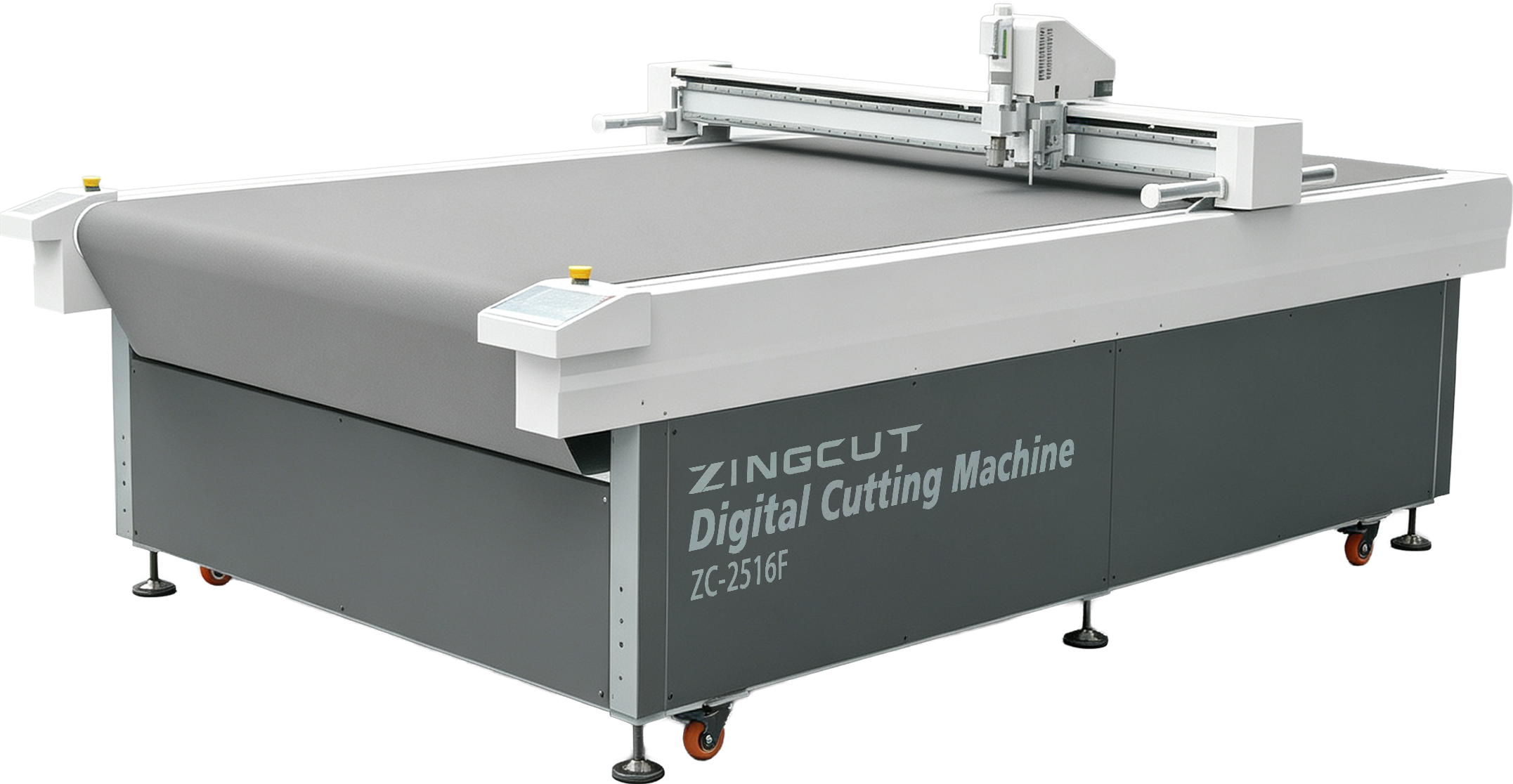
Stable cutting quality is inseparable from solid machine structure and reliable material fixation system. ZINGCUT composite cutting machine adopts industrial integrated frame, hidden button design and upgraded vacuum adsorption system, fully adapting to complex composite processing scenarios.
4.1 Integrated Industrial Frame & Hidden Installation Design
The whole machine adopts thickened steel integrated welding frame, which effectively eliminates machine vibration during high-speed cutting. No shaking means no cutting offset, ensuring micron-level stable precision for long-time composite batch production. The streamlined hidden installation buttons simplify operation, keep the equipment surface neat, avoid dust accumulation, and reduce daily maintenance difficulty.
4.2 Working Principle of Suction Zone & Vacuum Pipeline System
The biggest difficulty in composite cutting is material fixation, and ZINGCUT’s core advantage lies in its zoned vacuum suction system.
The machine table is divided into independent partitioned suction zones, matched with high-power vacuum blower and optimized circulating vacuum pipelines. When working, the vacuum system quickly extracts air between the material and the table surface, forming uniform negative pressure adsorption.
– For soft and stretchable dry fiber fabrics: overall uniform suction fixes the flatness of the fabric, completely avoiding stretching and wrinkling during cutting.
– For sticky prepreg materials: stable negative pressure prevents material shifting caused by blade friction.
– For fragile honeycomb composite panels: adjustable vacuum pressure fits different structural hardness, firmly fixing the material without crushing the honeycomb core structure.
The segmented suction design supports partial opening and closing of the suction area according to the material size, which not only ensures fixing stability but also saves energy consumption, perfectly solving various material deformation and displacement problems in composite processing.
5. Tungsten Steel Blade: Solve Composite Cutting Tool Loss Problem
Abrasive composite materials have always been the “killer” of ordinary blades. Ordinary steel blades wear quickly when cutting carbon fiber and fiberglass, resulting in blunt cutting, poor edge quality and frequent replacement.
ZINGCUT is equipped with professional high-hardness tungsten steel blades customized for composite materials.
Tungsten steel material features ultra-high hardness, strong wear resistance and anti-abrasion performance. Facing the strong friction and abrasion of carbon fiber and glass fiber, the blade maintains long-term sharpness without rapid wear and passivation.
It greatly extends the service life of the blade, reduces the frequency of consumable replacement, and lowers the overall production cost. Whether it is long-time continuous mass production or frequent small-batch prototype cutting, tungsten steel blades always maintain stable cutting sharpness and consistent finished edge quality, helping composite factories achieve low-loss, high-efficiency sustainable production.
6. Conclusion
To wrap up, composite cutting commonly struggles with delamination, fraying, heat damage, unstable material holding and fast blade wear. The ZINGCUT digital vibrating cutter addresses these headaches with cold physical cutting, removing the requirement for costly low-temperature processing. Its rigid integrated frame, zoned vacuum suction system and durable tungsten steel blades deliver clean cuts, stable positioning and extended tool life. For composite fabricators, this translates to less scrap, fewer consumable changes and flexible production, boosting your overall ROI.