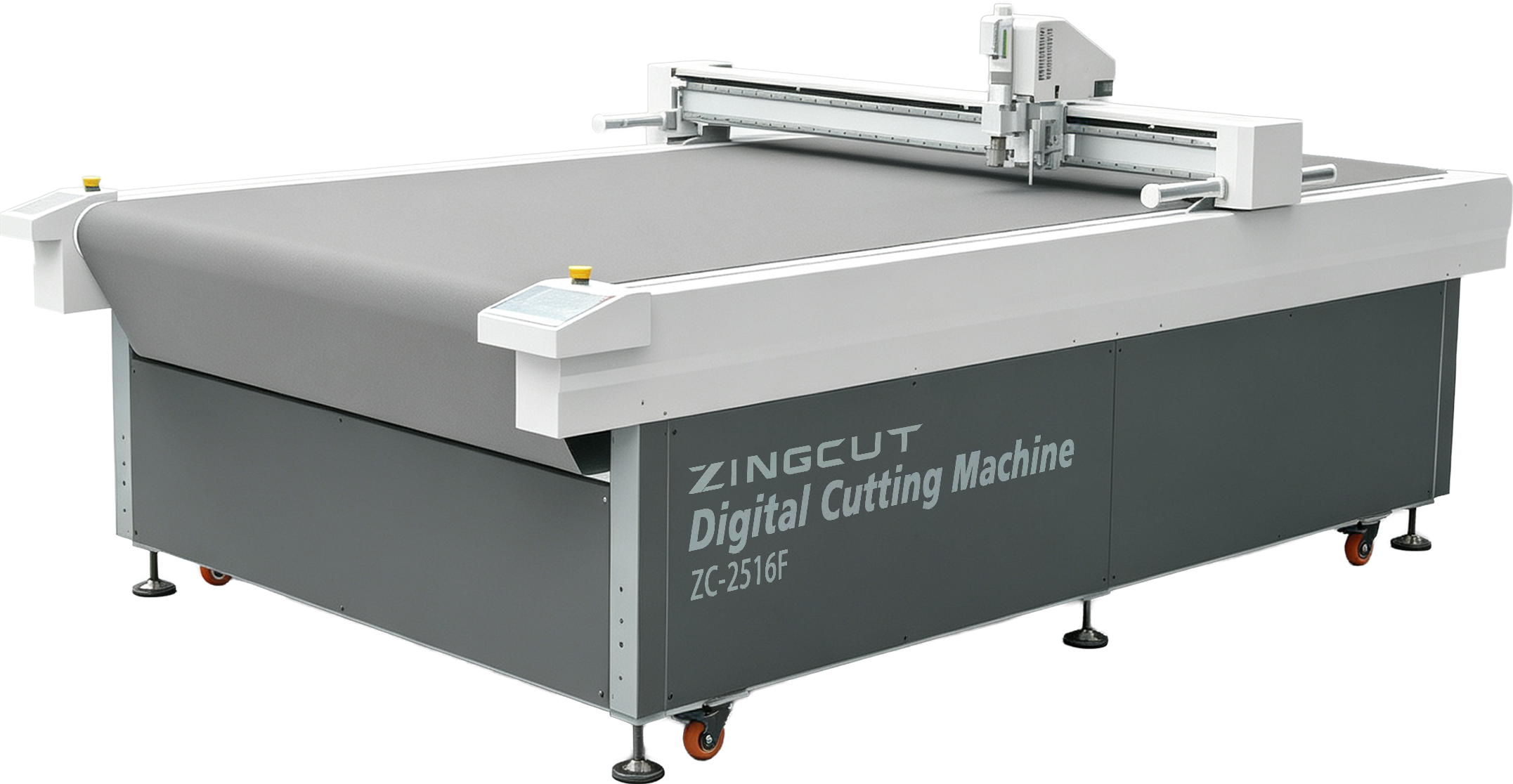
1. Introduction: Why Flexible Cutting in Furniture “Looks Simple but Is Hard to Do”
Flexible cutting sounds like the easy part of furniture manufacturing. You put foam, fabric, or leather on a table, the machine follows a path, and out comes a cut piece. What could possibly go wrong?
Quite a lot, as it turns out. The moment you deal with materials that compress, stretch, shift, and melt, the physics starts arguing with the brochure. That is why flexible cutting in furniture often looks simple on paper and feels surprisingly stubborn on the shop floor.
1.1 Material Characteristics: How Do Foam Rebound, Fabric Drift, and Composite Delamination Add Up?
The physical properties of flexible materials are inherently at odds with mechanical cutting logic. Foam is compressed under the blade and rebounds after cutting, so dimensions easily drift. Fabric and leather tend to shift during conveying, and the cutting path follows. Composite materials must simultaneously balance interlayer bonding and cut-edge quality. Any one of these issues is troublesome on its own; together, they amplify errors all the way to assembly. When material compatibility is addressed upfront, furniture makers can avoid the “cut inaccurately — adjust parameters — rework” loop after the machine is installed.
1.2 Order Trends: What Changes When Small Batches, Multiple Varieties, and Irregular Shapes Increase?
Furniture orders are increasingly moving toward small-batch customization, with higher changeover frequency, a larger share of irregular shapes, and tighter delivery rhythms. If a machine is slow to change over and has too many interruptions when cutting irregular shapes, productive hours are gradually eaten away. ZINGCUT treats fast changeover, parameter reuse, and path planning for irregular shapes as part of the machine’s capability, helping furniture companies maintain cycle times under small-batch fast turnaround. The more small orders you run, the more this changeover-efficiency calculation matters.
1.3 Evaluation Criteria: From “Can It Cut?” to “Can It Cut Accurately, Cleanly, and Change Over Fast?”
When evaluating a flexible cutting machine, don’t just look at whether it can cut through the material. Look at dimensional accuracy, cut-edge quality, changeover efficiency, and long-term stability. ZINGCUT builds its system matching around “accurate cutting, clean cutting, and fast changeover,” and supports on-site trial cutting with actual order materials. Verify with real materials before choosing a machine, and hidden costs after installation will be lower.
2. Dimensions and Deformation: How Can Flexible Materials Be Cut Accurately?
Cutting flexible materials accurately is a bit like measuring a sleeping cat: the moment you press down, the shape changes. Foam compresses, fabric shifts, leather stretches, and composite materials add a second layer of opinions. The machine may follow the path perfectly, but the material has its own idea of where that path should land. Accurate cutting, therefore, is not just a motion-control problem. It is a material-behavior problem.
2.1 Foam Cutting: How Should Dimensional Compensation Be Handled Before, During, and After Cutting?
Foam is compressed when the blade presses down, and after cutting it rebounds, so dimensions easily deviate. This can lead to poor fit or wrinkles during upholstery assembly. ZINGCUT configures dimensional compensation logic before, during, and after cutting based on foam rebound characteristics, reducing dimensional drift caused by rebound. Dimensional consistency directly determines assembly fit in upholstery. Get the compensation right, and rework naturally decreases.
2.2 Fabric and Leather: How Can Conveying Drift Be Dynamically Synchronized and Corrected?
Fabric and leather easily shift during conveying and cutting. Once the path drifts, the cut edge and dimensions drift with it. The machine needs dynamic synchronization and offset correction so that conveying and cutting actions stay matched. Once fabric drift exceeds the allowable range, the result at assembly is wrinkles and poor fit. Correction capability is the foundation of yield rate.
2.3 Composite Foam: How Can Interlayer Bonding and Edge Burrs Be Balanced?
Cutting composite foam requires not only dimensional control but also interlayer bonding, reducing separation, delamination, and edge burrs. The machine should match blade edge and feed parameters to the characteristics of the composite material, balancing interlayer bonding and cut-edge flatness. Composite material yield often gets stuck on delamination and burrs. Parameter matching is more cost-effective than post-cutting trimming.
2.4 Multi-Head Coordination: Where Are the Bottlenecks in Dynamic Synchronization and Offset Compensation?
Multi-head cutting improves efficiency, but it also brings dynamic synchronization errors and delayed compensation for material offset. Once consistency between heads gets out of control, efficiency gains are offset by rework. Multi-head cutting is not simply adding more heads. If coordination is poor, it is better to stabilize consistency first.
3. Cut-Edge Process Windows: What Heat Input, Blade Edge, and Speed Conditions Do Different Materials Need?
If material deformation is about where the cut lands, the cut-edge process window is about what the edge looks like when the blade leaves. And this is where flexible materials get picky. Some want as little heat as possible. Some want a sharp edge and a fast feed. Some want a gentle approach so the layers stay bonded. Treat them all the same, and you get a collection of melted edges, fuzzy edges, and edges that look fine until you try to sew them.
The process window is simply the range of conditions — heat input, blade condition, feed speed, and sometimes assistive cooling — within which a given material cuts cleanly. Outside that window, the material lets you know. The trick is knowing which window applies to which material, and having a machine that can actually operate inside it.
3.1 Heat-Sensitive Materials: How Can the Cut Edge Stay Flat Without Adhesion?
Chemical fiber fabrics, coated leather, and flame-retardant foam are sensitive to heat input during cutting. Poor heat input control leads to edge melting, adhesion, and discoloration. To keep the cut edge flat, non-sticky, and color-stable, actual processing needs to be carried out under lower thermal impact, low-temperature assistance, or cold cutting conditions, keeping heat input, blade condition, and feed speed within the right process window. ZINGCUT provides process configurations for low thermal impact, low-temperature assistance, or cold cutting for such materials. When the cut edge is clean, subsequent edge binding and sewing run smoothly, and manual secondary trimming costs come down.
3.2 Foam Cutting: How Should Blade Sharpness and Feed Speed Be Matched?
Foam cutting requires matching blade sharpness and feed speed; otherwise, compression rebound, stringing, edge collapse, and uneven cut surfaces easily occur. The machine should match blade and feed parameters to foam density and thickness to reduce stringing and edge collapse. Cut-surface flatness directly affects the appearance of foam products and downstream processing efficiency.
3.3 Multi-Layer Composites: How Can Delamination During Cutting Be Reduced?
Multi-layer composites require balancing the cutting characteristics of different materials to avoid separation between surface and bottom layers, delamination, or uneven edges. Process parameter matching and cutting path optimization can balance interlayer bonding and edge quality. Delamination often leads to complete scrap. Machine-side control is more reliable than post-production repair.
3.4 Process Boundaries: What Materials Are Laser, Oscillating Knife, and Waterjet Each Suited For?
Different cutting methods have different material boundaries. Using one method for all materials often means being good at nothing. The key is to choose the right cutting method for foam, genuine leather, and composite fabrics. Choosing the right process window is more practical than buying a machine that “can cut everything.Different cutting methods have different material boundaries. Using one method for all materials often means being good at nothing. The key is to choose the right cutting method for foam, genuine leather, and composite fabrics. Choosing the right process window is more practical than buying a machine that “can cut everything.
4. Small-Batch Fast Turnaround: Can Changeover Efficiency and Path Planning Keep Up with Order Rhythms?
4.1 Changeover Setup: How Can Time Loss Be Compressed?
As small-batch custom orders increase, changeover setup time directly affects productive hours. ZINGCUT supports fast changeover and parameter reuse, reducing repeated setup. Changeover time saved is productive capacity gained. The more small orders you run, the more obvious this calculation becomes.
4.2 Irregular-Shape Processing: How Can Frequent Tool Changes and Manual Feeding Be Reduced?
General-purpose machines tend to require frequent tool changes and manual feeding when handling complex irregular shapes, affecting both cycle time and yield rate. The machine needs optimized path planning and continuous processing capability for irregular shapes. As the share of irregular shapes rises, continuous processing capability directly determines yield rate and cycle time.
4.3 Multi-Head Paths: How Can Idle Travel and Zoning Coordination Be Optimized?
Multi-head machines need to optimize idle travel ratio, zoning coordination, and dynamic task adjustment; otherwise, efficiency gains are eaten up by unnecessary movement. Idle travel wastes labor hours and energy. Path optimization is a real efficiency gain.
5. Long-Term Stability: What Sustains Precision Retention and Table Cleanliness?
5.1 Low-Cost Assembled Machines: How Can Precision Drift and Parts Compatibility Issues Be Avoided?
Low-cost assembled machines are prone to precision drift, higher scrap rates, and deteriorating tool compatibility. They are cheap at purchase but expensive in use. ZINGCUT systematically matches its parts system and precision retention design to reduce the risk of precision drift during long-term use. A machine is a long-term capacity purchase, not a precision discount six months later.
5.2 Table Cleaning: How Does Dust Buildup Affect Cutting Stability?
Dust buildup affects cutting deviation, dimensional errors, and equipment uptime. If daily cleaning cannot keep up, stability is hard to maintain. ZINGCUT machines can be paired with a dedicated vacuum cleaner to clean the table surface, reducing the impact of dust buildup on cutting stability. When cleaning is built into the solution, daily operation and maintenance become more worry-free.
5.3 Maintenance Mechanism: How Should a Service Plan and Fault Feedback System Be Established?
Furniture manufacturing sites commonly lack a maintenance system and smooth fault feedback, and unplanned downtime often starts there. Establishing a service plan, inspection records, and a fault feedback mechanism at delivery helps ensure that maintenance is in place, unplanned downtime is reduced, and equipment uptime is protected.
6. Machine Selection: From “Reading Specs” to “Trial Cutting with Materials” and Total Cost of Ownership
6.1 Low-End vs. Over-Spec Machines: How Can Two Selection Pitfalls Be Avoided?
Blindly choosing a low-end machine leaves insufficient precision and material compatibility. Blindly going for the top configuration leaves functions idle and maintenance burdens heavy. Configuration should match the actual material mix and order structure, without piling on useless features or sacrificing key precision. Spending money where it matters is more important than simply comparing unit prices.
6.2 Trial Cutting with Materials: What Metrics Should Actually Be Measured?
Machine selection should not be based only on unit price. Material compatibility and precision compensation should come first, followed by changeover efficiency, multi-head coordination, and total maintenance cost over the life cycle. Calculate the total cost before comparing unit prices to avoid the trap of “cheap to buy, expensive to use.”
Paper specifications cannot fully represent actual cutting results. ZINGCUT supports on-site trial cutting with actual order materials, measuring cutting quality, speed, nesting utilization, changeover time, and continuous operation stability. A machine verified by trial cutting carries lower risk after installation.
6.3 Selection Checklist: How Should Material Compatibility, Precision Compensation, Changeover Efficiency, Head Coordination, and Maintenance Cost Be Prioritized?
7. Breaking the Deadlock: From “Buying a Machine” to “Building Capability”
7.1 Material–Process–Machine Matching: How Should You Choose for Foam, Genuine Leather, and Composite Fabrics?
First clarify material characteristics and cut-edge requirements, then choose the process route. If the machine and material are mismatched, no amount of adjustment will feel right. Get the matching right, and yield rate and efficiency have a foundation.
7.2 Precision Assurance: How Can Dynamic Compensation, Offset Correction, and Multi-Head Synchronization Be Implemented?
Precision needs to be guaranteed by system capability, not by temporary parameter adjustment. ZINGCUT uses dynamic compensation, offset correction, and multi-head synchronization control to make dimensional accuracy and consistency a sustainable capability. Precision is not something you tune in; it is something the machine’s capability supports.
7.3 Flexible Production: How Should Fast Changeover, Intelligent Nesting, and Reduced Idle Travel Be Combined?
Small-batch fast turnaround requires combined capability. A single feature alone can hardly keep up with order rhythms. Fast changeover, intelligent nesting, and path optimization work together to improve flexible production capability. The stronger the combined capability, the greater the profit margin under small-batch fast turnaround.
7.4 Maintenance System: How Can Service Plans, Dust Control, and Fault Feedback Form a Closed Loop?
Long-term stability depends on a maintenance closed loop. If any link — service, cleaning, or feedback — breaks, precision and uptime are affected. Forming a closed loop across service, dust control, and fault feedback, and pairing it with a dedicated vacuum cleaner for table cleaning, reduces long-term precision drift and unplanned downtime.
7.5 Acceptance Method: Why Is Trial Cutting with Real Materials More Reliable Than Paper Specs?
Paper specifications cannot fully represent actual cutting results. Trial cutting with real materials more easily exposes material compatibility, precision, and changeover issues. Using actual order materials for trial-cutting acceptance brings the selection decision closer to real production.